



Amoebic Liver Abscess

Clinical Findings
Signs and Symptoms
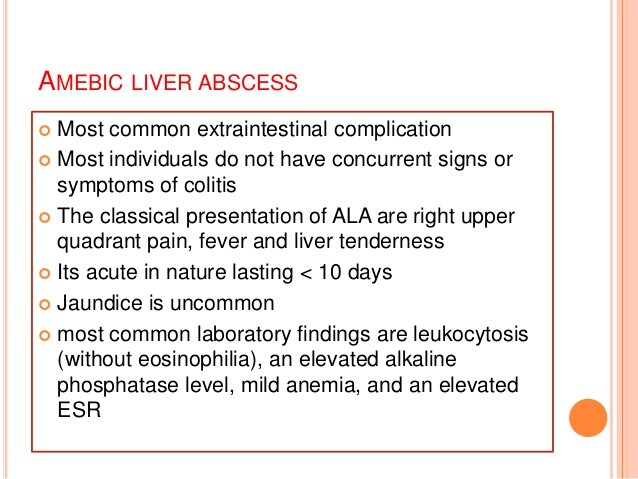
Amebic liver abscess is the most common extraintestinal manifestation of amebiasis. Patients may report right upper quadrant pain that is either dull or pleuritic in nature. Pain is often referred to the right shoulder. Fewer than 50% of patients have an enlarged liver. In the acute setting, patients typically present with fever. If symptoms have been present for more than 2 weeks, fever is present in fewer than half of patients. Respiratory symptoms, such as cough, can occur even in the absence of pulmonary disease and may be the only complaint. In the subacute setting, weight loss is common. Diarrhoea is found in fewer than one-third of patients with amebic liver abscess.
Because the presentation can be subtle or can mimic other causes of abdominal pain and fever, clinicians often consider the overall pattern of symptoms together with travel or exposure history.
Examination may reveal abdominal tenderness, tender hepatomegaly, and crackles at the right lung base. Jaundice is uncommon.
Laboratory Findings
Patients with amebic liver abscess may have leukocytosis without eosinophilia, elevated alkaline phosphatase, and mild anaemia. The transaminases are elevated in severe disease. Other findings include a high erythrocyte sedimentation rate and proteinuria.
These abnormalities are non-specific and cannot, by themselves, confirm the diagnosis, but they support suspicion of amebic liver disease when they occur in the appropriate clinical context.

Imaging
Liver ultrasound may show a round or oval hypoechoic area contiguous with the liver capsule and without significant wall echoes. This is often a single lesion in the right hepatic lobe. Computed tomography (CT) scanning and magnetic resonance imaging are sensitive studies for hepatic involvement, but the finding of a mass is not specific for amebic abscess. Each of these studies allows definition of the number of lesions as well as their size, and this information may be used to monitor a patient's course.
Imaging findings alone do not distinguish amebic abscess from bacterial or malignant lesions, so they must be interpreted together with clinical, laboratory, and serological data.
Differential Diagnosis
An amebic liver abscess needs to be differentiated from other mass lesions of the liver, including bacterial abscess, echinococcal cyst, hepatoma, and metastatic cancer.
Complications
Amebic liver abscesses may rupture and thereby extend into surrounding tissues, including the pleural space, lung parenchyma, and pericardium. Pleural effusion may be present without frank rupture of the abscess.
Pleuropulmonary amebiasis. Pleuropulmonary disease is the most common complication of amebic liver abscess and usually presents with cough and pleuritic chest pain. Findings may include a serous effusion, which does not imply disseminated disease. Amebic empyema, with "anchovy paste" material present on drainage, occurs with rupture of the abscess into the pleural space and is associated with increased mortality. Consolidation of the lung parenchyma may occur with contiguous spread from a liver abscess. A patient who develops a hepatobronchial fistula will have a cough productive of large amounts of sputum and necrotic material, with the sputum possibly containing detectable amebas.
Peritoneal amebiasis. Peritoneal amebiasis occurs in 2-7% of patients with amebic liver abscess and represents the second most common complication of amebic liver abscess. The presentation may be dramatic enough to simulate a perforated viscus, or it may be more indolent, with a slow leak of organisms into the peritoneal space.
Pericardial amebiasis. Pericardial disease is a rare but serious complication of amebic liver abscess. It usually results from rupture of an abscess in the left lobe of the liver and presents with fever and chest pain, before progressing to congestive heart failure, tamponade, and shock.
Cerebral amebiasis. Cerebral amebiasis is rare, with reports from clinical series of fewer than 0.1% of patients. Autopsy series of patients with known amebiasis show central nervous system involvement of 1-2%. Cerebral abscess should be suspected in a person with known amebiasis who presents with mental status changes or focal neurological signs.
Genitourinary amebiasis. Renal infection may occur either from direct extension of hepatic disease or by haematogenous or lymphatic spread. Genital lesions typically arise from fistulae from hepatic or colonic disease and present with painful ulcers with profuse discharge.
| Complication | Typical presentation | Key concern |
|---|---|---|
| Ruptured hepatic abscess | Acute abdominal or chest pain with signs of peritonitis or pleuritic symptoms | Extension into pleural space, lung parenchyma, or pericardium |
| Pleuropulmonary amebiasis | Cough, pleuritic chest pain, pleural effusion, or productive sputum | Empyema with thick "anchovy paste" material and risk of increased mortality |
| Peritoneal amebiasis | Acute abdomen mimicking perforated viscus or more gradual abdominal symptoms | Leakage of organisms into the peritoneal cavity |
| Pericardial amebiasis | Fever, chest pain, and progressive shortness of breath | Development of tamponade, shock, and heart failure |
| Cerebral amebiasis | Mental status changes or focal neurologic deficits | Central nervous system abscess with high morbidity and mortality |
| Genitourinary amebiasis | Painful genital ulcers with profuse discharge or signs of renal involvement | Local tissue destruction and fistula formation |
Diagnosis
The diagnosis of intestinal infection with E histolytica or E dispar is made by demonstrating cysts or trophozoites in the stool, or by examining biopsy specimens of mucosal tissue. Amebic trophozoites are destroyed by many agents, including antibiotics, antidiarrhoeal agents, barium, and tap water. Therefore, stool specimens should be examined by preparing wet mounts within 20 minutes of collection and examining them immediately. Staining with iodine and trichrome maximises the yield of positive specimens. Pathogenic trophozoites of E histolytica may be distinguished from non-pathogenic species by the presence of ingested erythrocytes within the organism.
Careful sample handling and examination by experienced personnel are essential, because organisms may be missed if the specimen is delayed or processed incorrectly.
Serology is useful for diagnosing E histolytica infection. Antibodies to ameba develop only with infection by E histolytica and do not develop with E dispar infection. With invasive colitis or hepatic abscess, antibodies may be negative initially but become positive by 7-10 days in 85-95% of patients. Antibodies cannot distinguish current infection from remote infection, because antibodies may remain positive for years.
Monoclonal antibodies and polymerase chain reaction technology are newer methods used for diagnosing amebic infection and appear to allow differentiation of E histolytica from E dispar. An enzyme-linked immunoabsorbent assay with monoclonal antibodies to a region that contains epitopes unique to E histolytica has been used to make this distinction in preliminary studies.
As these tools become more widely available, they may improve the accuracy and speed of diagnosis, particularly in reference laboratories.
| Method | Primary target | Comments |
|---|---|---|
| Stool microscopy | Cysts and trophozoites in stool | Requires rapid processing and special stains such as iodine or trichrome |
| Endoscopic or surgical biopsy | Tissue trophozoites in colonic mucosa | Helps distinguish invasive disease from other causes of colitis |
| Serological testing | Antibodies to E histolytica | Useful in invasive colitis or hepatic abscess; may remain positive for years |
| Antigen detection assays | Parasite antigens unique to E histolytica | Enzyme-linked immunoabsorbent assays with monoclonal antibodies can detect specific epitopes |
| Polymerase chain reaction (PCR) | Parasite DNA | Newer method that can distinguish E histolytica from E dispar |
| Imaging studies | Hepatic fluid collections and mass lesions | Ultrasound, CT, or MRI define size and number of lesions but are not specific |
| Percutaneous aspiration | Abscess fluid | Used when the diagnosis is uncertain or when rupture or lack of response is suspected |
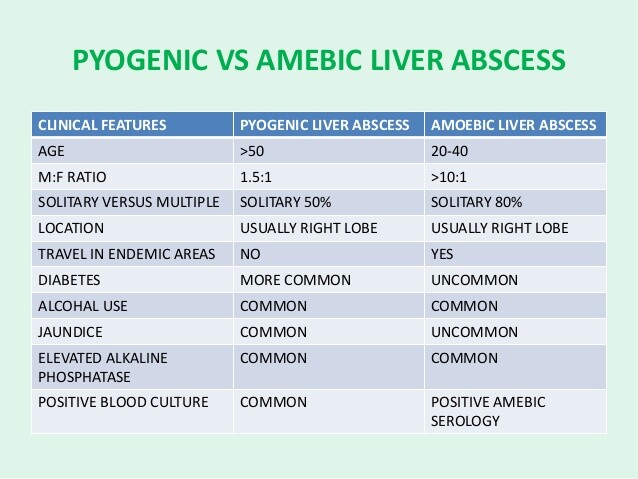
Amebic liver abscess should be suspected in any patient with an abnormal abdominal examination and appropriate risk factors, such as recent travel to an endemic area. Once a hepatic fluid collection is demonstrated radiographically, it is important to distinguish amebic abscess from pyogenic abscess. Serology is again useful but may be negative for the first week of infection. Percutaneous sampling of the fluid is often required to look for cysts and trophozoites. Amebas may not be found in the liquefaction centre of an abscess, but the results of Gram stain, culture, and serology will usually distinguish amebic abscess from other causes.
Diagnosis of infection at other extraintestinal sites requires clinical suspicion in the appropriate setting, such as in a patient with known amebic abscess. Demonstration of amebas in these extrahepatic sites is not universally required but is often obtained, because drainage is required for empyema, peritoneal involvement, and usually pericardial involvement.
Treatment
Treatment of amebic disease requires both elimination of the trophozoite form from the intestine or extraintestinal sites and elimination of cysts from the intestine. If a luminal agent is not used to eradicate cysts, the disease may recur.
Metronidazole is the agent of choice for treating amebic colitis. Doses of 750 mg three times daily for 5-10 days are extremely effective, and the drug can be given orally or intravenously. Side effects are generally gastrointestinal: nausea, vomiting, and abdominal discomfort. If taken with alcohol, metronidazole produces a disulfiram-like reaction. The drug carries a potential risk of teratogenicity if used in pregnant women; however, because amebic disease is often more serious in pregnant women, treatment is generally recommended. No teratogenic effects were seen in more than 2500 women inadvertently given metronidazole during pregnancy. In Europe, two additional nitroimidazole antibiotics (tinidazole and ornidazole) are available, provide effective therapy, and are associated with fewer adverse effects than metronidazole. These drugs are not available in the United States.
Tetracycline or erythromycin is effective therapy for milder cases of colitis. Because these drugs will not eradicate ameba in the liver, their use should probably be restricted to patients who cannot tolerate metronidazole. Emetine and dehydroemetine have relatively high toxicity and must be given in a monitored environment. They offer no benefit over standard metronidazole therapy.
Three luminal agents are available for eradication of cysts after treatment with metronidazole or other agents. Diloxanide furoate has greater than 90% efficacy but must be obtained from the Centers for Disease Control and Prevention in the United States. Iodoquinol (diiodohydroxyquin) requires 20 days of therapy and is in limited supply in the United States. Because of its high iodine content, it may interfere with thyroid function tests and should be avoided in those allergic to iodine. Other side effects include gastrointestinal discomfort, fever, and headache. Paromomycin is a non-absorbable aminoglycoside that may cause loose stools. It is often preferred in circumstances in which systemic absorption is undesirable, such as in pregnancy.
Amebic liver abscess responds to medical therapy, and, as with intestinal disease, metronidazole is the preferred agent. When given as a 5- to 10-day treatment, metronidazole has a cure rate of greater than 95%. The role of aspiration or drainage is unclear but is usually not necessary. Because of the high response rate to medical therapy, aspiration is probably best reserved for a few defined circumstances. In a patient who is not clinically improved within 3 days of initiation of therapy, aspiration is used to confirm the diagnosis and exclude other causes of abscess, such as bacterial infection. Aspiration is also indicated for a ruptured abscess and for an abscess at risk of rupture, characterised by a large fluid collection surrounded by a thin rim of hepatic tissue. If a left-lobe abscess is in danger of involving the pericardium, aspiration should be performed.
Medical therapy is generally sufficient for amebiasis involving the genitourinary tract, central nervous system, and lung parenchyma. Involvement of the pericardium and pleural space may require drainage because of the development of loculations. In general, treatment plans combine a tissue-active agent for invasive disease with a luminal agent to clear intestinal cysts, helping to prevent relapse and ongoing transmission.
Prognosis
Although infection with E histolytica can be debilitating, it is generally not life-threatening. Effective treatment exists once infection is identified. Relapse or reinfection is not unusual. Only a small minority of patients develop severe complications, such as colonic perforation, toxic megacolon, ruptured hepatic abscess, or cerebral amebiasis.
Prevention & Control
Prevention of amebic infection is greatly enhanced by effective sanitation and a clean water supply. Cysts are resistant to destruction by chlorine, but iodine or boiling is sufficient to kill the organism. Health education and public health efforts to identify and treat carriers may limit disease spread. Travellers to endemic areas should avoid unpeeled fruit and vegetables and should avoid drinking water unless it has been properly treated. Several vaccines against E histolytica are under development and may provide the most effective means of disease control once released.
Good hand hygiene, safe food and water practices, and timely evaluation of gastrointestinal or hepatic symptoms are important for people living in or returning from endemic areas. Individuals with questions about their personal risk or prevention strategies should discuss them with a healthcare provider.