



Shigella species

Essentials of Diagnosis
- Enteritis caused by Shigella species may be watery (Shigella sonnei, Shigella boydii) or dysenteric (Shigella dysenteriae, Shigella flexneri).
- Risks include ingestion of faecally contaminated food or water and contact with infected individuals.
- A definitive diagnosis requires microbiological isolation and identification of a Shigella species or molecular evidence of infection.
General Considerations
Epidemiology
Dysentery is an ancient disease and has been described throughout the ages. It was not until the 19th century that dysentery was recognised as being caused by either parasitic amoebae or certain bacteria. In 1898, Shiga recognised and isolated bacteria from patients with dysentery that would agglutinate when exposed to the patient's serum. Today, the most commonly recognised agents of bacterial dysentery are Shigella species and EIEC (see above).
Shigella species are unique among bacterial enteric pathogens in that < 200 and possibly = 10 organisms may traverse the gastric acid barrier and cause disease. For this reason, person-to-person transmission is common. Person-to-person transmission results in increased frequencies of shigellosis in day care centres, schools, and custodial-care facilities. The disease is most common in infants and young children, and it frequently occurs in family members of patients. Peak incidence occurs in the summer, and common houseflies are thought to contribute to disease spread. Outbreaks have also occurred as a result of faecally contaminated food. Transmission through contaminated water is most common in developing countries that lack adequate sewage and water treatment facilities.
In the United States, S sonnei is the most commonly encountered Shigella species, whereas S boydii has a worldwide distribution. The prevalence of shigellae appears to be cyclical, with replacement of the predominant strain approximately every 20 years. This cycling is presumably secondary to slowly acquired herd immunity in a given host population. Epidemic shigellosis, caused by S dysenteriae and S flexneri, is prevalent in underdeveloped countries, but it may develop anywhere that poverty, overcrowding, or conditions of war exist.
Microbiology
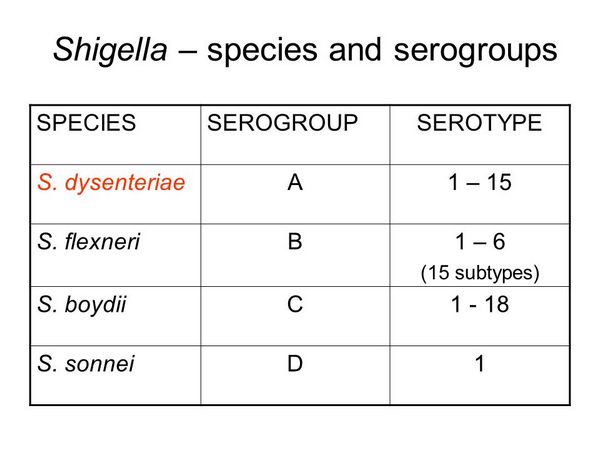
Shigella are non-motile, facultative anaerobic, Gram-negative bacilli that are closely related to the genus Escherichia. At least 40 serotypes comprise four groups or species: S dysenteriae (serogroup A), S flexneri (serogroup B), S boydii (serogroup C), and S sonnei (serogroup D).
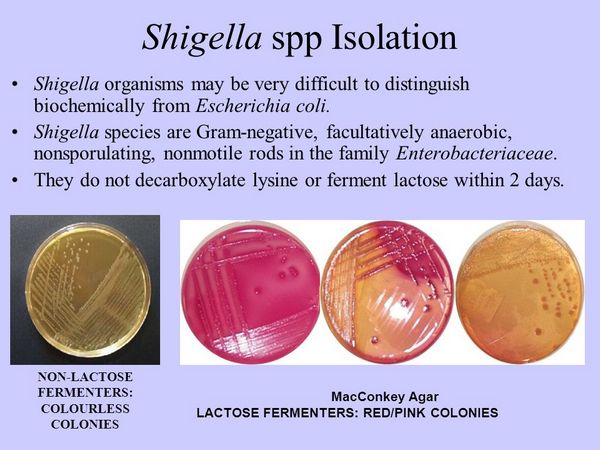
The numbers of shigellae present in stool vary with the course of disease. Early in the watery diarrhoea phase, shigellae are abundant and number 103-109 shigellae/g of faeces. During this phase, shigellae are easily recovered on MacConkey or eosin methylene blue (EMB) agar, where they appear as lactose-non-fermenting colonies. Later in the course of disease, during the dysentery and post-convalescent phases, bacterial stool counts decline to 102-103 shigellae/g of faeces. Furthermore, recovery of shigellae is inversely proportional to specimen transport time, especially in stool specimens with low numbers of shigellae. During this later phase, culture is best accomplished by rapid specimen transport or bedside medium inoculation, combined with the use of enrichment broth and moderately to highly selective media, such as xylose-lysine-desoxycholate medium and Shigella-Salmonella medium.
In many laboratories, suspect colonies (lactose non-fermenters) are screened using a three-tube set: (i) one tube containing triple sugar iron (TSI) or Kligler iron agar (KIA), (ii) the second containing lysine iron agar (LIA), and (iii) the third containing Christensen's urea agar (CU) (see also the Salmonella Microbiology section below). On TSI and KIA, shigellae characteristically produce an alkaline slant and acid butt without gas production. Rare isolates may produce gas. Negative reactions are produced on LIA and CU because shigellae do not decarboxylate lysine or hydrolyse urea. In addition, shigellae do not produce hydrogen sulphide, which is detected by the TSI, KIA, and LIA systems. Agglutination of organisms suspected to represent Shigella species may be attempted using group antisera. Isolates with a suggestive screening profile are then further characterised by additional biochemical reactions in either traditional or automated systems.
Useful clues in identifying shigellae include the following: most shigellae cannot ferment mucate, cannot use acetate, and are negative for indole and ortho-nitrophenyl-ß-galactopyranoside.
Pathogenesis
Shigellosis may produce either predominantly watery diarrhoea or watery diarrhoea that progresses to dysentery. Disease severity is largely determined by the invading organism. S dysenteriae and S flexneri are the agents most commonly associated with bacillary dysentery, whereas other Shigella species more often produce watery diarrhoea.
The pathogenesis of the watery diarrhoea phase of bacillary dysentery is caused by a combination of luminal bacterial replication and superficial mucosal invasion in the small intestine. During this phase, large numbers of shigellae are present in the lumen of the small intestine. This phase correlates with the onset of cramping abdominal pain, fever, and toxaemia.
Within days, the luminal contents of the small intestine no longer contain shigellae, and the site of infection becomes the colon. Shigellae invade the colonic mucosa and occasionally invade to the level of the submucosa. Factors that are important for invasion are present on the bacterial chromosome, as well as on a 140-MDa plasmid. Eventually, epithelial cell death occurs and the mucosa sloughs, possibly secondary to shigatoxin production. Loss of mucosa evokes an intense inflammatory response and allows coliform bacteria to be introduced. Microabscesses, epithelial ulcerations, and pseudomembranes that consist of sloughed epithelial cells, bacteria, fibrin, and inflammatory cells may be seen. This phase correlates with tenesmus and fractionated stools that contain blood, mucus, and inflammatory debris.
Clinical Findings
Signs and Symptoms
Early in the course of disease, when bacteria are present in the small intestine, patients develop acute watery diarrhoea, fever, and abdominal pain. Patients may become toxemic, and fever may reach as high as 104°F (40°C). Later in the course of disease, the primary site of infection is the colon. During this phase, fever continues but is usually less pronounced. Pain is usually in the lower abdominal quadrants. Stools become dysenteric and consist of a mixture of neutrophils, blood, mucus, and debris. Frequent, small-volume or fractionated stools may occur, and tenesmus is often present. Patients experience pain on rectal examination. Colonoscopy discloses hyperaemic and friable-to-ulcerated colonic mucosa.
Differential Diagnosis
When watery diarrhoea predominates, other bacterial, parasitic, and viral enteric pathogens must be considered. Entamoeba histolytica and EIEC must also be considered in patients with dysentery. Infection with E histolytica is most commonly associated with travel to, or living in, endemic locations. These organisms are readily recognised on microscopic examination of the stool for ova and parasites. Dysentery caused by EIEC, however, may pose a diagnostic challenge for the clinical microbiologist. EIEC, unlike other E coli, are often non-motile; may not ferment lactose or may ferment it slowly; are lysine decarboxylase negative; and may cross-react with Shigella antisera. Laboratory personnel must recognise this potential pitfall and exclude this organism through additional testing (see above).
Non-infectious causes of diarrhoea must also be considered. The differential diagnosis of non-infectious colitis is extensive and includes inflammatory bowel disease, lymphocytic/collagenous colitis, neoplasia, and numerous other disorders. Patients with inflammatory bowel disease may also have faecal leukocytes, which limits the usefulness of this test. An accurate diagnosis may be achieved through a thorough history and physical examination, exclusion of enteric pathogens through appropriate microbiological studies, and obtaining and reviewing gastrointestinal biopsies via endoscopy and histopathological studies.
Complications
The most common complications of bacillary dysentery include dehydration and protein-losing enteropathy. In rare instances, toxic megacolon may occur and may result in perforation, intra-abdominal haemorrhage, peritonitis, and possibly death. Some patients, particularly those with HLA-B27 phenotypes, may develop post-infectious arthritis or Reiter's syndrome.
Diagnosis
Patients with acute diarrhoea, which may range from watery to dysenteric, fever, abdominal pain, and systemic symptoms/toxaemia may have shigellosis. A history of exposure to individuals with shigellosis, travel to endemic areas, and exposure to high-risk populations (for example, people in a custodial-care facility) should raise the index of suspicion. The presence of leukocytes in stool, although supportive, is by no means definitive for shigellosis. Faecal leukocytes may be present in stools of patients with other bacterial enteritides, amoebic dysentery, pseudomembranous colitis, and non-infectious disease such as inflammatory bowel disease. A definitive diagnosis requires microbiological identification of a Shigella species.
Shigellae are particularly susceptible to some environmental changes, and they die rapidly during transport. Therefore, it is imperative to transport stool from patients suspected of having shigellosis to the laboratory rapidly. This is especially important for patients in the later stages of disease, in whom the number of shigellae in stool is relatively low.
Where available, molecular tests can complement stool culture and may increase detection in patients who present late in the course of illness or who have already received antibiotics.
Treatment
Fluid and electrolyte replacement is necessary for patients with dehydration. In most instances, this is readily accomplished with oral rehydration. Unlike in many other bacterial enteritides, antibiotic therapy is important in the treatment of shigellosis. Antibiotic therapy limits the clinical course of disease, may decrease the likelihood of intestinal complications, and decreases faecal excretion of viable pathogenic organisms, which in turn reduces transmission. Fluoroquinolones are the treatment of choice for adults. TMP/SMX is the treatment of choice for children. Alternatives include ampicillin, chloramphenicol, and nalidixic acid. In areas of known resistance to TMP/SMX, such as parts of South-East Asia, Africa, and South America, quinolones should be used for adults, and one of the above-mentioned alternatives should be used for children with shigellosis. When available, the antimicrobial susceptibility profile should guide therapy.
Antimotility agents, such as diphenoxylate, should not be used. Inhibition of diarrhoea increases contact between the intestinal mucosa and pathogenic organisms and their toxins, and it may cause more fulminant disease.
In all cases, antimicrobial choice should take into account local resistance patterns and individual factors, including age, comorbid conditions, pregnancy status, and history of drug allergy.
| Patient group / setting | Preferred therapy | Alternatives and notes |
|---|---|---|
| Adults | Fluoroquinolones (treatment of choice) | Use antimicrobial susceptibility results when available. Alternatives include ampicillin, chloramphenicol, or nalidixic acid when quinolones are contraindicated or not suitable. |
| Children | TMP/SMX (treatment of choice) | If resistance to TMP/SMX is present, use one of the listed alternatives (ampicillin, chloramphenicol, or nalidixic acid) as appropriate and guided by susceptibility testing. |
| Regions with known TMP/SMX resistance (for example, parts of South-East Asia, Africa, South America) | Adults: fluoroquinolones | Children: ampicillin, chloramphenicol, or nalidixic acid selected according to local resistance data and clinical response. |
Prognosis
The prognosis is generally good for patients with endemic or sporadic shigellosis. Infants and older adults, especially if malnourished, have the highest mortality. Epidemic shigellosis caused by S dysenteriae, however, is a severe and often life-threatening disease with mortality rates from 5% to 20%. This disease must be treated aggressively with antimicrobial and rehydration therapies.
Prevention & Control
The development and refinement of sewage disposal and drinking water treatment systems are important in developing countries. In both developed and developing countries, personal hygiene, good hand-washing practices, and clean living conditions are important preventive measures, particularly in custodial-care facilities. Fly control and hygienic food preparation practices should also reduce the incidence of disease.
Because the infectious dose is low and person-to-person spread is efficient, even modest improvements in hygiene and environmental sanitation can substantially reduce transmission in high-risk settings.
| Setting | Main measures | Examples |
|---|---|---|
| Community and municipal level | Safe water and sewage management | Improved sewage disposal, reliable drinking water treatment systems, and protection of water sources from faecal contamination. |
| Households and custodial-care facilities | Personal hygiene and environmental cleanliness | Regular hand washing with soap, careful nappy and waste handling, routine cleaning of shared surfaces, and minimising crowding when possible. |
| Food and vector control | Safe food handling and fly control | Thorough hand washing before food preparation, keeping food covered, proper cooking and storage, and reducing housefly breeding sites around kitchens and latrines. |