Praziquantel is a synthetic anthelmintic medicine that is structurally unrelated to other anthelmintic medicines currently available. In UK clinical practice, it is used in specialist infectious diseases and travel medicine settings for parasitic infections.
Praziquantel (Biltricide) Uses
Trematode (Fluke) Infections
Schistosomiasis
Praziquantel is used to treat schistosomiasis (bilharzia) caused by all Schistosoma species that are pathogenic in humans. It has been used effectively both for individual patients and in mass-treatment and control programmes.
Praziquantel is effective against all stages of Schistosoma infection, including the acute and chronic phases, which may involve the liver and spleen. The drug appears to be effective in severe schistosomiasis (for example, neuroschistosomiasis). However, to help prevent substantial illness and long-term complications such as paraplegia or persistent impotence, treatment with praziquantel must be started promptly. Treatment may be started in patients with suspected neuroschistosomiasis while confirmatory test results are pending.
Adult schistosomes do not multiply inside the human body, so the worm burden depends on the intensity and frequency of infection and the worm's lifespan. Mature schistosomes continually produce eggs, most of which are retained in body tissues, triggering an immune granulomatous response, tissue damage, and scarring. How severe the disease becomes is linked to how heavy the infection is. Antischistosomal drugs work by greatly reducing the worm burden and therefore preventing further egg production.
Praziquantel has produced cure rates of 75-95% and/or egg reduction rates of 80-98% in patients with schistosomiasis and is considered the treatment of choice for infections caused by Schistosoma (S.) haematobium, S. japonicum, S. mansoni, or S. mekongi. It is the only anthelmintic currently available that has been shown to be effective for infections caused by S. intercalatum or S. mekongi. Oxamniquine (no longer commercially available in the UK) is considered an alternative to praziquantel for infections caused by S. mansoni. The use of niridazole or antimony salts for S. japonicum infections has been replaced by praziquantel because of lower toxicity and better efficacy.
The effectiveness of praziquantel in schistosomiasis may vary depending on the patient's age and the severity of infection. Cure rates are generally lower in children and in patients with heavy infections.
Travelers
Travellers to endemic areas of the Caribbean, South America, Africa, and Asia are at risk of schistosomiasis. Because there is no practical way for travellers to tell infested water from non-infested water, freshwater swimming in rural areas of endemic countries should be avoided. Outbreaks of schistosomiasis have occurred among adventure travellers taking part in river trips in Africa, as well as among expatriates and Peace Corps volunteers living in high-risk areas.
Those at greatest risk are travellers who wade, swim, or bathe in freshwater in areas where sanitation is poor and suitable snail hosts are present. To reduce the risk of illness linked to delayed recognition of schistosomal infection, UK travel health guidance advises travellers and expatriates who have had freshwater exposure (for example, recreational exposure) and who are returning from Schistosoma-endemic areas to have serological screening for infection. Following thorough clinical evaluation, seropositive individuals in the UK should receive praziquantel treatment.
Neuroschistosomiasis should be suspected in any person with central nervous system (CNS) abnormalities who has returned from an endemic area. These infections can occur several months after exposure to infested water, and eggs may be undetectable or difficult to identify in urine and stool. Presumptive treatment with praziquantel should be started promptly whenever there is a strong suspicion of infection and should not be delayed while waiting for confirmatory tests.
Clonorchiasis and Opisthorchiasis
Praziquantel is used to treat clonorchiasis caused by Clonorchis sinensis (Chinese liver fluke) and opisthorchiasis caused by Opisthorchis viverrini (South-East Asian liver fluke). Praziquantel has produced cure rates of 86-98% in patients with clonorchiasis or opisthorchiasis and is currently considered the treatment of choice for these infections.
Other Trematode Infections
Praziquantel has been used effectively to treat other trematode (fluke) infections caused by Paragonimus westermani (lung fluke), Metagonimus yokogawai (intestinal fluke), Nanophyetus salmincola (formerly Troglotrema salmincola) (intestinal fluke), Heterophyes heterophyes (intestinal fluke), Fasciolopsis buski (intestinal fluke), and Metorchis conjunctus (North American liver fluke), and is currently considered the treatment of choice for these infections.
Praziquantel has been used in a limited number of patients for infections caused by Fasciola hepatica (sheep liver fluke), but the drug was inactive against this trematode in vitro in one study and treatment failures have been reported. For that reason, other agents (for example, bithionol or triclabendazole, where available) are preferred for these infections. Praziquantel has also been effective in a limited number of patients with infections caused by P. kellicotti (American lung fluke), P. heterotrema (lung fluke), and P. uterobilateralis (African lung fluke).
Cestode (Tapeworm) Infections
Praziquantel has been used to treat cestodiasis (tapeworm infections) caused by certain cestodes that are pathogenic in humans, including Diphyllobothrium latum (fish tapeworm), Dipylidium caninum (dog and cat tapeworm), Taenia saginata (beef tapeworm), and T. solium (pork tapeworm).
Praziquantel or niclosamide is currently considered the treatment of choice for infections caused by these cestodes. Praziquantel has also been used to treat infections caused by Hymenolepis nana (dwarf tapeworm) and is currently considered the treatment of choice for these infections.
Praziquantel is effective against the adult, juvenile, and larval stages of these cestodes. Although niclosamide and paromomycin are effective for cestodiasis caused by T. solium, some clinicians consider praziquantel the treatment of choice for this infection because niclosamide and paromomycin cause the worm segments to disintegrate and release viable eggs. This may carry a theoretical risk of cysticercosis developing; niclosamide is not effective against cysticerci.
Praziquantel has also been used effectively to treat cysticercosis caused by Cysticercus cellulosae (the larval or tissue stage of T. solium), and praziquantel or albendazole is currently considered the treatment of choice for this infection.
Although praziquantel has been effective in treating adult Echinococcus infections in dogs, studies in rodents and sheep have failed to show any efficacy against larval Echinococcus infections (hydatid cysts). It is therefore unlikely that these infections in humans will respond to the drug. Surgical removal of the cysts or, when surgery is contraindicated or cysts rupture spontaneously during surgery, mebendazole or albendazole is currently considered the treatment of choice.
Because praziquantel can kill Echinococcus (for example, protoscoleces), it may be useful for perioperative prophylaxis or if cyst contents spill during surgery.
Praziquantel has been used effectively, preferably together with corticosteroids, to treat neurocysticercosis caused by T. solium. In a limited number of patients, praziquantel treatment has been shown to produce a long-term reduction in seizure frequency and in the frequency and severity of episodes of raised intracranial pressure, and radiographic evidence has shown a reduction in the number and size of cysts.
Because nervous system side effects (cerebrospinal fluid (CSF) reaction syndrome) occur frequently during praziquantel treatment for neurocysticercosis, more study is needed to fully determine the balance of benefit and risk in this condition. Occasionally, ventricular shunting for hydrocephalus and, more rarely, surgical removal of cysts (for example, in the ventricles and/or basal cisterns) may be necessary.
Most clinicians recommend using corticosteroids at the same time as praziquantel in patients with neurocysticercosis to reduce the frequency and severity of praziquantel-induced nervous system side effects.
In the United Kingdom, patients having praziquantel treatment for neurocysticercosis usually should be admitted to hospital for the duration of treatment. Because praziquantel-induced CSF reaction syndrome may be more hazardous in patients with spinal cysticercosis than in other forms of neurocysticercosis, some clinicians have recommended that the drug should not be used for this condition. Spinal cysticercosis generally requires surgery to relieve spinal cord dysfunction caused by compression or an intramedullary mass.
The drug has been ineffective in a limited number of patients with intraocular cysticercosis, and the manufacturer and some clinicians state that praziquantel should not be used for this condition because of the risk of irreversible intraocular lesions caused by killing the cysts.
Dosage and Administration
Administration
Praziquantel is taken by mouth. The tablets should not be chewed, but they can be halved or quartered to allow individualised dosing. Patients should be told to swallow praziquantel tablets, halves, and/or quarters immediately with enough liquid during meals, as keeping the tablets or tablet pieces in the mouth may cause gagging or vomiting because of the drug's bitter taste.
Some clinicians state that regurgitation while taking the tablets may theoretically predispose the patient to developing cysticercosis during treatment for T. solium infections.
Dosage
Trematode (Fluke) Infections: Schistosomiasis
For the treatment of schistosomiasis caused by all species of Schistosoma pathogenic to humans, the usual dose of praziquantel recommended by the manufacturer in adults and children aged 4 years and older is 60 mg/kg given in 3 equally divided doses on the same day.
Some clinicians recommend lower doses (40 mg/kg given as a single dose or in 2 equally divided doses), which have been effective in some patients with schistosomiasis. Some clinicians recommend that adults and children with schistosomiasis caused by S. haematobium or S. mansoni receive praziquantel 40 mg/kg in 2 equally divided doses on the same day, and that those with infections caused by S. japonicum or S. mekongi receive 60 mg/kg in 3 equally divided doses on the same day.
Clonorchiasis and Opisthorchiasis
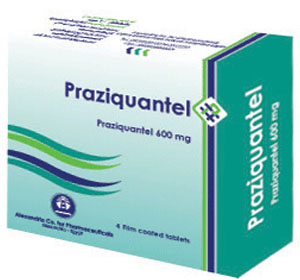
For the treatment of infections caused by Clonorchis sinensis or Opisthorchis viverrini, the usual dose of praziquantel in adults and children is 75 mg/kg given in 3 equally divided doses on the same day. Lower doses (40-50 mg/kg given as a single dose) have been effective in some patients; however, these doses may be associated with lower cure rates.
Other Trematode Infections
For the treatment of trematodiasis caused by Fasciolopsis buski, Heterophyes heterophyes, or Metagonimus yokogawai, the usual dose of praziquantel in adults and children is 75 mg/kg given in 3 equally divided doses on the same day.
Nanophyetus salmincola
For the treatment of trematode infections caused by Nanophyetus salmincola, the usual dose of praziquantel in adults and children is 60 mg/kg given in 3 equally divided doses on the same day.
For the treatment of trematodiasis caused by Fasciola hepatica, a dose of 25 mg/kg 3 times daily for 5-8 days has been used in a limited number of adults and children, but treatment failures have occurred.
Paragonimus westermani
For the treatment of trematode infections caused by Paragonimus westermani, the usual dose in adults and children is 25 mg/kg 3 times daily for 2 days. For the treatment of trematodiasis caused by P. uterobilateralis, a dose of 25 mg/kg 3 times daily for 2 days has been effective.
Cestode (Tapeworm) Infections: Adult (Intestinal) Stage
For the treatment of cestodiasis caused by Diphyllobothrium latum, Dipylidium caninum, Taenia saginata, or T. solium, the usual dose of praziquantel in adults and children is 5-10 mg/kg given as a single dose. For the treatment of cestodiasis caused by Hymenolepis nana, the usual dose in adults and children is 25 mg/kg given as a single dose.
Larval (Tissue) Stage
For the treatment of cysticercosis caused by Cysticercus cellulosae, the usual dose of praziquantel in adults and children is 50-100 mg/kg given in 3 divided doses daily for 30 days.
A praziquantel dose of 50 mg/kg given in 3 equally divided doses daily for 14 or 15 days has usually been used for the treatment of neurocysticercosis; this dose has also been used for 21 days in a few patients.
Because of the risk of praziquantel-induced nervous system side effects, most clinicians recommend that corticosteroids (for example, dexamethasone 6-24 mg daily, prednisone 30-60 mg daily) should be given at the same time as praziquantel in patients with neurocysticercosis.
Although the potential benefit of additional courses of praziquantel in adults with neurocysticercosis has not been determined, some clinicians suggest that repeated courses may be useful in patients whose cysts show only partial resolution 3 months after a course or whose condition worsens.
Cautions
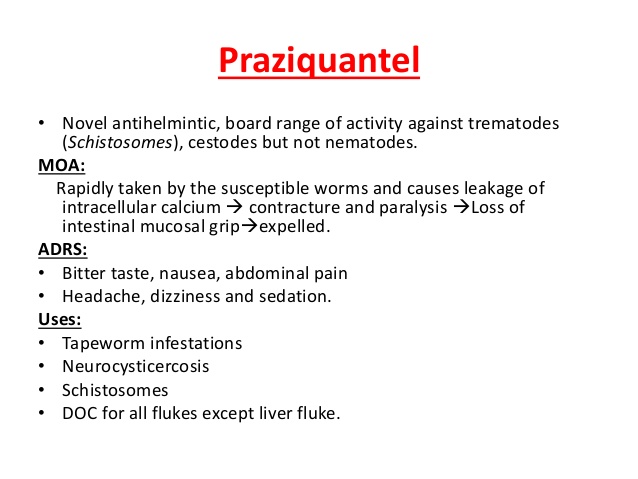
At recommended doses, praziquantel is generally well tolerated. Side effects are common but are usually temporary and mild to moderate, and they usually do not require treatment. Some side effects may be due to the parasitic infection being treated and/or to dead and dying parasites rather than to the drug itself, and they may be more common and/or more severe in patients with a heavy worm burden.
Nervous System Effects
Nervous system side effects occur frequently with praziquantel; however, most are mild and temporary. The most common are dizziness, headache, and malaise. Other nervous system side effects include drowsiness and lassitude (fatigue). Giddiness has been reported rarely.
Nervous system side effects (CSF reaction syndrome), including headache, worsening of neurological signs and symptoms such as seizures, increased CSF protein concentrations and anticysticercal immunoglobulin G (IgG) levels, arachnoiditis, meningism, hyperthermia, and intracranial hypertension, occur in almost all patients during praziquantel treatment for neurocysticercosis and may rarely be life-threatening.
CSF reaction syndrome is thought to result from an intense inflammatory response to dead and dying larvae in the CNS and may be similar to the Jarisch-Herxheimer reaction seen during penicillin treatment for syphilis. The risk of serious reactions is probably related to the number, size, and location of viable cysts in the CNS. Concomitant use of corticosteroids during praziquantel treatment for neurocysticercosis reportedly substantially reduces the frequency and severity of these nervous system side effects.
GI Effects
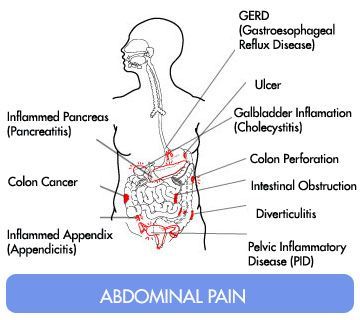
Gastrointestinal (GI) side effects occur frequently. Abdominal pain or discomfort, with or without nausea, occurs in about 90% of patients receiving the drug. Vomiting, epigastric pain, loss of appetite, urge to defecate, and diarrhoea have also been reported.
GI reactions, mainly colicky, cramping abdominal pain, can occasionally be severe and may come on suddenly within 1 hour of taking the drug. These reactions may be accompanied by fever, sweating, and bloody stools.
Hepatic Effects
Mild to moderate, temporary increases in serum aspartate aminotransferase (AST; formerly SGOT) and/or alanine aminotransferase (ALT; formerly SGPT) concentrations have occurred in about 3-27% of patients receiving praziquantel. However, there has been no evidence of serious drug-induced hepatic effects, even in patients with schistosomal infection associated with severe hepatosplenic involvement.
Other Adverse Effects
Urticaria, rash (for example, maculopapular rash), pruritus, low back pain, myalgia or arthralgia, fever or a hot sensation, sweating, palpitation, and hypotension have been reported in some patients receiving praziquantel.
Small increases in eosinophil count have occurred in a few patients with schistosomiasis treated with the drug. However, eosinophilia is also associated with schistosomiasis and may also be a consequence of a host-mediated immune response to antigen release during drug-induced killing of the worms. Similarly, urticaria may result from an immune response to antigen release from the worms.
Although praziquantel has been shown to produce a positive inotropic effect on rat atria in vitro, this effect has not been reported so far in humans receiving the drug, and the clinical importance of this finding has not been determined.
Precautions and Contraindications
Patients should be warned that praziquantel may impair their ability to carry out activities that require mental alertness or physical coordination, such as operating machinery or driving. The manufacturer recommends that patients avoid such activities on the day of treatment and the following day.
Some clinicians state that praziquantel should be used with caution in patients with a history of seizures. Praziquantel is contraindicated in patients who are hypersensitive to the drug. The manufacturer and some clinicians also state that the drug is contraindicated in patients with intraocular cysticercosis. In addition, some clinicians recommend that praziquantel should not be used in patients with spinal cysticercosis.
Pediatric Precautions
The safety of praziquantel in children younger than 4 years of age has not been established.
Mutagenicity and Carcinogenicity
It is not known whether praziquantel is mutagenic or carcinogenic in humans. Although one laboratory reported praziquantel to be mutagenic in bacteria, these results have not been reproducible, and other studies have not shown the drug to be mutagenic in bacteria or mammalian cells.
The drug has been shown to act as a comutagen, increasing the mutagenicity of several mutagenic and/or carcinogenic chemicals in vitro in bacteria and animal cells. No evidence of carcinogenesis was seen in animals receiving oral praziquantel doses of up to 250 mg/kg once weekly for 2 years.
Pregnancy, Fertility, and Lactation
Reproduction studies in rats and rabbits using praziquantel doses up to 40 times the usual human dose have not revealed evidence of harm to the fetus. An increase in the rate of spontaneous abortion occurred in rats following administration of praziquantel doses 3 times the usual human dose.
There are no adequate and controlled studies to date of praziquantel use in pregnant women, and the drug should be used during pregnancy only when clearly needed. It is not known whether praziquantel affects fertility in humans. Reproduction studies in rats and rabbits using praziquantel doses up to 40 times the usual human dose have not revealed evidence of impaired fertility.
Since praziquantel passes into breast milk, women should temporarily stop breastfeeding on the day of praziquantel treatment and for 72 hours after the last dose.
Drug Interactions
Oxamniquine: Although the clinical importance is unclear, limited evidence from one study in mice indicates that the antischistosomal activity of praziquantel and oxamniquine may be synergistic against Schistosoma mansoni when the two drugs are given together.
Acute Toxicity
Limited information is available on the acute toxicity of praziquantel.
The acute lethal dose of praziquantel in humans has not been determined. Toxicology studies in animals have shown that the oral median lethal dose (LD50) of praziquantel is about 2.5 g/kg in mice, about 2.8 g/kg in rats, 1.05 g/kg in rabbits, and greater than 200 mg/kg in dogs. However, an actual acute oral lethal dose could not be established in dogs because of the emetic effect of the drug in this species.
Although there has been no experience to date with acute praziquantel overdose in humans, the manufacturer states that a fast-acting laxative should be given after acute ingestion of an overdose.
Mechanism of Action
Activity Against Trematodes
The exact way praziquantel works against trematodes (flukes), including its activity against schistosomiasis, is not fully understood. Praziquantel appears to directly kill susceptible adult schistosomes in vivo. In addition, the medicine causes dead or dying worms to become dislodged from their usual sites in the mesenteric or pelvic (for example, vesical plexus) veins and move to the liver, where they are retained and then trigger tissue reactions in the host (for example, phagocytosis).
This dislodging seems to happen mainly because the worm muscles contract and become paralysed, and their suckers are then immobilised. As a result, the worms detach from the blood vessel wall and are passively carried away by normal blood flow. The drug-induced contraction and the subsequent paralysis in the contracted state appear to result from increased permeability of the cell membrane of susceptible worms to calcium, with a resulting influx of calcium ions.
After praziquantel is given, intense focal vacuolisation and subsequent disintegration occur at distinct sites of the schistosomal integument. This vacuolisation and disintegration create surface defects and cause most schistosomes to lose their normal copulatory position, which substantially reduces oviposition (egg laying).
Limited evidence suggests that male S. mansoni worms may be more susceptible than females; however, evidence from animal studies indicates that all worms were dead 7 days after treatment. The number of worms affected and the degree of integumental injury appear to be dose related; in addition, the degree of injury increases with time after treatment.
Animal studies using experimentally induced schistosomal infections indicate that praziquantel is active against all developmental stages of schistosomes, including miracidia and cercariae (the free-swimming larvae that emerge from the intermediate snail host).
Activity Against Cestodes
Although the exact mechanism of praziquantel's activity against cestodes (tapeworms) has not been established, the drug generally does not kill susceptible adult cestodes in vivo, but causes the worms to be dislodged from their usual sites in the intestine. This seems to result from drug-induced impairment of the worms' suckers.
The effects of praziquantel against cestodes are concentration dependent in vitro. At low concentrations (1-10 ng/mL), the drug stimulates cestode motility and impairs the function of their suckers. At higher concentrations, contraction of the strobila (chain of proglottids) occurs; at very high concentrations (greater than 1000 ng/mL), contraction is immediate and irreversible.
Praziquantel also causes irreversible focal vacuolisation and subsequent disintegration at specific sites of the cestodal integument. These lesions are limited to the growth zone of the neck region; the proglottids in the central and posterior parts of the strobila are not affected.
Spectrum
Praziquantel has a broad spectrum of anthelmintic activity. It is active against many trematodes, including schistosomes, and also against many cestodes.
Trematodes
Praziquantel is active against all Schistosoma species that are pathogenic to humans, including S. mansoni, S. haematobium, S. japonicum, S. mekongi, and S. intercalatum. In vitro, susceptible schistosomes are rapidly killed by praziquantel concentrations of 0.3 mcg/mL and above.
Praziquantel has also been shown to be active against other trematodes, including the liver flukes Clonorchis sinensis, Opisthorchis viverrini, and Fasciola hepatica; the lung flukes Paragonimus westermani, P. uterobilateralis, and P. kellicotti; and the intestinal flukes Metagonimus yokogawai, Nanophyetus salmincola, Fasciolopsis buski, and Heterophyes heterophyes.
Cestodes
Praziquantel has been shown to be active against adult, juvenile, and larval stages of certain cestodes that are pathogenic to humans, including Diphyllobothrium latum, Dipylidium caninum, Hymenolepis nana, Taenia saginata, T. solium, and Cysticercus cellulosae.
Pharmacokinetics
Absorption
Praziquantel is well absorbed after oral administration. About 80% of an oral dose is absorbed from the gastrointestinal tract; however, because of extensive first-pass metabolism, only a small proportion reaches the systemic circulation as unchanged praziquantel. Peak serum concentrations occur about 1-3 hours after usual oral doses. In one study of healthy adults, a single 50-mg/kg dose produced peak serum drug concentrations of about 1 mcg/mL at 1-2 hours.
Distribution
The distribution of praziquantel into human tissues and body fluids has not been fully characterised. In studies in rats, concentrations of free (unbound) praziquantel in CSF were similar to those in serum. The concentration of the drug in CSF is reported to be 14-20% of the concurrent total (free plus protein-bound) plasma concentration. Praziquantel passes into breast milk at concentrations about 25% of maternal serum concentrations.
Elimination
Praziquantel has a serum half-life of about 0.8-1.5 hours in adults with normal renal and hepatic function; however, the serum half-life of its metabolites is about 4-5 hours. Although the exact metabolic fate of praziquantel has not been clearly established, the drug is rapidly and extensively metabolised, mainly in the liver through hydroxylation to monohydroxylated and polyhydroxylated metabolites. It is not known whether these metabolites have anthelmintic activity.
Praziquantel and its metabolites are excreted mainly in the urine. After a single oral dose, about 70-80% of the dose is excreted in the urine within 24 hours, mainly as metabolites; less than 0.1% of an oral dose is excreted in the urine unchanged.
Chemistry and Stability
Chemistry
Praziquantel, a pyrazinoisoquinoline derivative, is a synthetic heterocyclic anthelmintic agent. The drug is structurally unrelated to other anthelmintic agents currently available. Praziquantel is a white to almost white, hygroscopic, crystalline powder with a bitter taste. It is very slightly soluble in water and soluble in alcohol.
Stability
Praziquantel tablets should be stored in tightly closed containers at a temperature below 30°C.