Cefadroxil (Duricef): Overview
Cefadroxil is an oral, first-generation cephalosporin (a beta-lactam antibiotic) used to treat mild to moderate infections caused by susceptible bacteria. In UK clinical practice, it may be prescribed when a doctor considers a cephalosporin appropriate for a confirmed or strongly suspected bacterial infection. It is closely related to cefalexin but usually gives more sustained plasma levels after dosing.
Duricef: What it is used for
Duricef for strep throat
Duricef (cefadroxil) may be prescribed for streptococcal pharyngitis/tonsillitis (strep throat) when the infection is confirmed or strongly suspected to be bacterial. Because many sore throats are viral, clinicians often use rapid testing or culture before choosing an antibiotic. For strep throat, it is important to complete the full prescribed course to help reduce complications and recurrence.
Duricef for skin infection
Duricef is commonly used for uncomplicated skin and soft tissue infections caused by susceptible staphylococci and streptococci, such as mild cellulitis, infected dermatitis, or other superficial bacterial skin infections. If an abscess has formed, drainage and local treatment may be needed as well as antibiotics.
Duricef for sinus infection
Sinus symptoms are often caused by viruses and may not need antibiotics. Duricef is not a universal first choice for sinus infections, but it may be used in selected cases of bacterial sinusitis when the suspected or confirmed bacteria are susceptible and a clinician considers it appropriate. Seek medical advice if symptoms are severe, last more than 10 days without improving, or get worse after initially improving.
Duricef for tooth infection
Dental (odontogenic) infections are often polymicrobial and commonly need source control (for example, dental drainage, root canal treatment, or extraction) alongside any antibiotic. In the United Kingdom, cefadroxil has been used in some orofacial/odontogenic infections, but antibiotic choice depends on severity, suspected bacteria (including anaerobes), and the patient's allergy history. Urgent dental or emergency assessment is needed if there is facial swelling, fever, spreading redness, difficulty swallowing, or breathing problems.
Cefadroxil: Uses and Administration
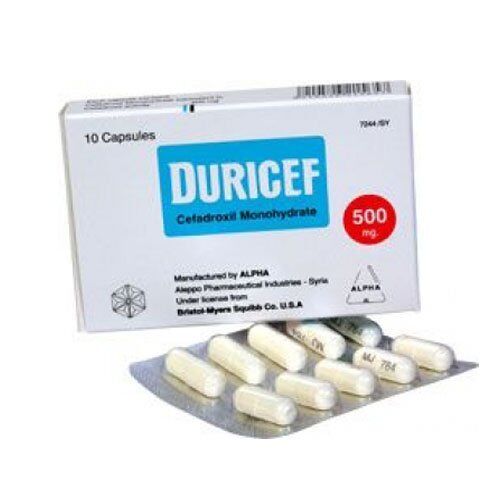
Duricef 250mg, 500mg Tablets
Cefadroxil is a first-generation cephalosporin antibiotic and the parahydroxy derivative of cefalexin. It is used in a similar way to treat mild to moderate susceptible infections. It is taken by mouth, and doses are expressed in terms of the anhydrous substance; 1.04 g of cefadroxil monohydrate is equivalent to about 1 g of anhydrous cefadroxil. The usual adult dose is 1 to 2 g daily as a single dose or in two divided doses. The following doses are used in children weighing less than 40 kg: 500 mg twice daily for those over 6 years of age, 250 mg twice daily for those aged 1 to 6 years, and 25 mg/kg/day in divided doses for infants under 1 year. For details of reduced doses of cefadroxil [Duricef 250mg, 500mg Tablets] in patients with renal impairment, see below. Cefadroxil [Duricef 250mg, 500mg Tablets] has also been used as the lysine derivative.
Administration in renal impairment
After an initial loading dose of 0.5 to 1 g, the dose of cefadroxil should be adjusted in patients with renal impairment according to creatinine clearance (CC):
- CC 26 to 50 mL/minute per 1.73 m2: 0.5 to 1 g every 12 hours
- CC 11 to 25 mL/minute per 1.73 m2: 0.5 to 1 g every 24 hours
- CC 10 mL/minute per 1.73 m2 or less: 0.5 to 1 g every 36 hours
Adverse Effects and Precautions
Common adverse effects
Cefadroxil is generally well tolerated. The most commonly reported side effects affect the gastrointestinal tract, such as nausea, vomiting, abdominal discomfort and diarrhoea, or involve hypersensitivity reactions such as rash, pruritus and urticaria. As with other antibiotics, cefadroxil may rarely cause antibiotic-associated colitis, including C. difficile-associated diarrhoea.
Precautions
Use cefadroxil with caution in patients with a history of hypersensitivity to cephalosporins. Cross-reactivity may occur in patients with penicillin allergy. Dose adjustment is needed in renal impairment (see above), and patients receiving prolonged therapy should be monitored clinically.
Breast feeding
Although higher concentrations of cefadroxil have been reported in breast milk than with cefalexin, cefalotin, cefapirin and cefotaxime, no detectable cefadroxil would be expected in breastfed infants, and no adverse effects have been seen in infants whose mothers were receiving cefadroxil. On that basis, cefadroxil is generally considered compatible with breast feeding in UK clinical practice.
Cefadroxil: Interactions
Probenecid may increase and prolong cefadroxil plasma concentrations by reducing renal tubular secretion. In British clinical practice, anticoagulants (for example, warfarin) may have enhanced effects when used with some antibiotics; consider clinical monitoring, such as INR, when cefadroxil is started or stopped in patients on anticoagulation. As with other antibiotics, cefadroxil may reduce the effectiveness of live bacterial vaccines (where applicable) if given at the same time.
Duricef and Alcohol
There is no well-known disulfiram-like reaction with cefadroxil. However, alcohol can make side effects such as stomach upset or dizziness worse and may slow recovery if you drink heavily. A cautious approach is to avoid or limit alcohol while you are unwell and taking antibiotics, and to follow your prescriber's advice.
Storage
- Tablets/capsules: Store at room temperature in a tightly closed container, away from heat, moisture and direct light. Do not freeze.
- Oral suspension (liquid): Store in the refrigerator. Do not freeze. Discard any unused portion after 14 days (or as directed on the label).
Antimicrobial Action
Cefadroxil is a bactericidal beta-lactam antibiotic that inhibits bacterial cell wall synthesis by binding to penicillin-binding proteins (PBPs), disrupting peptidoglycan cross-linking and leading to cell lysis. Its activity is typical of first-generation cephalosporins: good activity against susceptible Gram-positive organisms, including streptococci and methicillin-susceptible staphylococci, and limited Gram-negative coverage, commonly including E. coli, Proteus mirabilis and Klebsiella spp. Cefadroxil is not reliably active against MRSA, enterococci or Pseudomonas spp.
Pharmacokinetics
Cefadroxil is almost completely absorbed from the gastrointestinal tract. After oral doses of 500 mg and 1 g, peak plasma concentrations of about 16 and 30 micrograms/mL respectively are reached after 1.5 to 2 hours. Although peak concentrations are similar to those of cefalexin, plasma concentrations are more sustained. Taking it with food does not appear to affect the absorption of cefadroxil. About 20% of cefadroxil is reported to be bound to plasma proteins. The plasma half-life of cefadroxil is about 1.5 hours and is prolonged in patients with renal impairment. Cefadroxil [Duricef 250mg, 500mg Tablets] is widely distributed to body tissues and fluids. It crosses the placenta and appears in breast milk. More than 90% of a dose of cefadroxil may be excreted unchanged in the urine within 24 hours by glomerular filtration and tubular secretion; peak urinary concentrations of 1.8 mg/mL have been reported after a dose of 500 mg. Cefadroxil is removed by haemodialysis.
Cefadroxil (Duricef) is a convenient oral first-generation cephalosporin commonly used for susceptible skin infections and streptococcal throat infections, and it may be considered in selected cases of other bacterial infections when appropriate. For best results, take it exactly as prescribed and complete the full course. Patients with beta-lactam allergy, renal impairment, or those taking anticoagulants should seek medical advice and appropriate monitoring where needed.