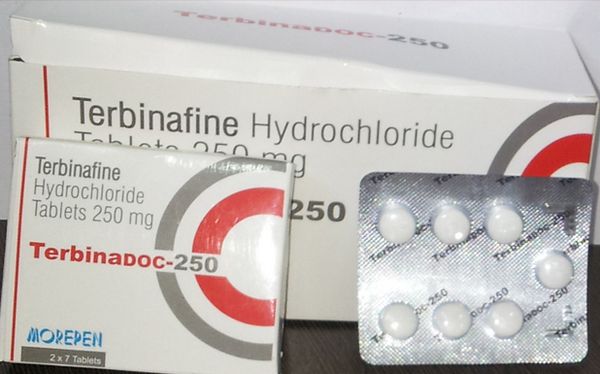
Terbinafine is a systemic (oral) allylamine antifungal medicine that inhibits squalene epoxidase. This blocks ergosterol production and causes squalene to build up inside the fungal cell, leading to fungal cell death. Terbinafine (Lamisil) 250 mg tablets are used to treat onychomycosis of the toenail or fingernail caused by dermatophytes.
Terbinafine (Lamisil) 250 mg tablets are a synthetic allylamine antifungal, structurally similar to naftifine.
Terbinafine (Lamisil) 250 mg tablets are well absorbed (>70%), but bioavailability is about 40% because of first-pass metabolism. In plasma, more than 99% of terbinafine is bound to plasma proteins. The effective half-life is about 36 hours; a terminal half-life of 200 to 400 hours may reflect slow elimination from tissues such as the skin and fat. Terbinafine is distributed into the sebum and skin.
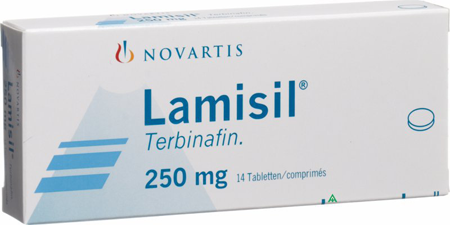
LAMISIL Tablets are contraindicated in patients with chronic or active liver disease. Use has not been studied adequately in patients with renal impairment (creatinine clearance ≤ 50 mL/min). Rifampicin increases terbinafine clearance and cimetidine decreases terbinafine clearance. The medicine is generally well tolerated, but rare serious side effects can include hepatotoxicity, severe neutropenia, Stevens-Johnson syndrome, toxic epidermal necrolysis and other serious skin reactions.
Available data in humans are insufficient to assess a drug-related risk in pregnancy; because treatment of onychomycosis can usually be postponed, discuss use during pregnancy with a healthcare professional.
Terbinafine (Lamisil) 250 mg is taken as one 250 mg tablet once daily. Fingernail onychomycosis: 6 weeks. Toenail onychomycosis: 12 weeks. The best clinical effect is often seen several months after mycological cure and completion of treatment, as healthy nail grows out. In the UK, oral terbinafine tablets are licensed for onychomycosis; use for other fungal infections may be outside the licensed indications and should be guided by a healthcare professional.
Terbinafine is also available in topical forms (such as cream or spray) in some markets. These products are used for certain superficial fungal skin infections and have separate directions for use.
Terbinafine Hydrochloride: Uses
Onychomycosis
Terbinafine is taken by mouth to treat dermatophyte infections of the toenail or fingernail (onychomycosis, tinea unguium) caused by susceptible fungi. Before starting oral terbinafine, appropriate nail samples should be taken for microbiological tests (for example, potassium hydroxide [KOH] preparation, fungal culture or nail biopsy) to confirm the diagnosis of onychomycosis. The best clinical effect of terbinafine in the treatment of onychomycosis is seen several months after mycological cure and completion of treatment, and reflects the time needed for healthy nail to grow out.
Because terbinafine is highly lipophilic and keratophilic, it reaches high concentrations in the stratum corneum, sebum, hair, and the nail matrix, bed and plate, and remains in these tissues for several weeks to months after the medicine is stopped. Toenail infections generally need longer treatment with terbinafine than fingernail infections.
The effectiveness of terbinafine has been established in uncontrolled studies and in placebo-controlled or active-comparator studies in patients with toenail or fingernail onychomycosis. In these studies, patients were assessed for mycological cure (no fungus seen in lesion scrapings prepared with potassium hydroxide, and negative culture of lesion scrapings), effective treatment (mycological cure plus either no nail involvement or more than 5 mm of unaffected new nail growth), or mycological and clinical cure (no nail involvement). Terbinafine has been shown to be active against most strains of Trichophyton rubrum and T. mentagrophytes both in vitro and in clinical nail infections. Although terbinafine is active in vitro against most strains of Epidermophyton floccosum, Candida albicans and Scopulariopsis brevicaulis, the effectiveness of the medicine in treating onychomycosis caused by these organisms has not yet been established in controlled clinical studies.
In toenail studies, 12 weeks of oral terbinafine 250 mg once daily was more effective than placebo or itraconazole 200 mg once daily, and 16 weeks of oral terbinafine at this dose was more effective than up to 52 weeks of oral griseofulvin 500 mg once daily. In these studies, 70-88% of patients achieved mycological cure, 59% achieved effective treatment, and 38-57% achieved mycological and clinical cure when assessed 36-48 weeks after completing terbinafine treatment; the clinical relapse rate was about 15% in those assessed at least 6 months after clinical cure and at least 1 year after completing terbinafine treatment.
In a study comparing 4 months of continuous (250 mg once daily) or intermittent (500 mg once daily for 1 week each month) oral terbinafine with intermittent (400 mg once daily for 1 week each month) oral itraconazole, there was a trend in favour of continuous terbinafine therapy, but there were no statistically significant differences in cure rates between the regimens. In a study comparing treatment durations of 6, 12 and 24 weeks in patients with toenail infections, mycological cure rates were substantially higher with the 12- and 24-week regimens than with the 6-week regimen, but the 24-week regimen was not substantially more effective than the 12-week regimen. However, some patients who do not respond to an initial 12-week course of terbinafine may respond to a second course.
In fingernail studies, 75% of patients achieved effective treatment, and 59-90% achieved mycological and clinical cure when assessed 18-42 weeks after completing treatment with oral terbinafine 250 mg once daily for 6 weeks. Extending terbinafine treatment to 12 weeks in patients with fingernail infections does not appear to improve response substantially. In one study of patients with fingernail onychomycosis who received oral terbinafine 250 mg once daily for 2 or 4 weeks, 65% had mycological and clinical cure 6 months after treatment ended; the cure rate in those who received only 2 weeks of treatment was 45%.
However, liver failure, sometimes leading to death or liver transplant, has occurred rarely in patients with or without pre-existing liver disease who were receiving terbinafine for the treatment of onychomycosis. Before starting oral terbinafine, patients should be assessed for liver disease; checking serum ALT (SGPT) and AST (SGOT) before treatment is advised for all patients.
Terbinafine should be stopped if biochemical or clinical signs of liver injury develop during treatment. Patients should be told to report any signs or symptoms of liver problems, such as persistent nausea, loss of appetite, fatigue, vomiting, pain in the upper right side of the abdomen, jaundice, dark urine or pale stools. Patients with these signs or symptoms should stop terbinafine and have their liver function checked straight away.
Other uses
In the UK, terbinafine tablets are licensed for onychomycosis; use for other fungal infections may be outside the licensed indications and should be directed by a healthcare professional. The safety and effectiveness of LAMISIL Tablets have not been established in paediatric patients.
Terbinafine: Organs and Systems
Sensory systems
Taste disturbance is a rare side effect of terbinafine. It is usually reversible, with a median time to recovery of 42 days. However, prolonged or persistent taste disturbances have been reported.
Haematological
Pancytopenia has been reported.
Leukocytes
Neutropenia has been reported in patients taking terbinafine.
- A 55-year-old woman taking terbinafine and paroxetine presented with fever, diarrhoea and vomiting. A bone marrow biopsy showed overall reduced cellularity, and the aspirate showed a profound shift towards the production of immature myeloid cells, consistent with maturation arrest. Treatment consisted of withdrawal of all outpatient medicines, hydration, intravenous fluids, broad-spectrum antibiotics and G-CSF 5 µg/kg for 5 days. Mature granulocytes appeared in the peripheral blood on the fifth day in hospital, and she was discharged on the seventh hospital day with an absolute neutrophil count of 6.2 x 10⁹/L. Paroxetine was restarted weeks after discharge without haematological toxicity over 6 months.
- A 60-year-old man presented with fever, oral mucositis, pedal cellulitis and bacteraemia after a 6-week course of terbinafine 250 mg. He was also taking yohimbine for impotence. Bone marrow examination showed a hypocellular marrow with myeloid maturation arrest. Treatment consisted of withdrawal of outpatient medicines, broad-spectrum antibiotics, hydration and G-CSF, and was ultimately successful. Yohimbine was restarted later without adverse effects.
- A 42-year-old man presented with fever and granulocytopenia (absolute neutrophil count: 340 x 106/L; temperature: 40°C (103.1°F)) after a 30-day course of oral terbinafine 250 mg/day for presumed onychomycosis. The granulocyte count recovered promptly after withdrawal of the medicine and administration of G-CSF for 2 days.
- Agranulocytosis occurred in a 15-year-old who took terbinafine 250 mg/day for toenail onychomycosis and tinea pedis. This effect was noted 4 weeks after starting terbinafine and resolved within 1 week after it was stopped.
Platelets
Thrombocytopenia has been attributed to terbinafine.
- A 25-year-old Yemeni woman with familial-ethnic leukopenia developed thrombocytopenia with epistaxis after taking terbinafine 250 mg for 4 weeks. The platelet count recovered from a nadir of 63 x 109/L to 314 x 109/L after the medicine was stopped.
- A 53-year-old woman developed severe thrombocytopenia after a 6-week course of terbinafine (250 mg/day) for onychomycosis. A bone marrow aspirate showed a normocellular marrow. She received a platelet transfusion and recovered after a short course of prednisolone.
Mouth
- A 38-year-old man presented with acute right otitis media and unrelated painless bilateral enlargement of the parotid glands 15 days after taking oral terbinafine for tinea cruris. He stopped taking terbinafine, and 12 days later the swelling had reduced significantly and disappeared completely 4 weeks later.
Liver
Minor abnormalities in liver function tests have been reported in patients taking oral terbinafine. Terbinafine can cause hepatitis, and rare cases of liver failure have been reported.
Skin
Skin side effects have been reported in patients taking terbinafine. Most of these reactions are mild to moderate macular rashes.
Generalised rashes, fixed drug eruptions, toxic epidermolysis and erythema exudativum multiforme have all been reported in association with terbinafine.
Storage
Store below 25°C (77°F) in a tightly closed container. Protect from light.