Lincomycin is an antibiotic that is structurally related to clindamycin. In UK practice, it may be used in specialist prescribing for bacterial infections.
In the United Kingdom, the PL number for lincomycin and products such as Lincocin is PL 0101/0118.
Uses
Staphylococcal and Streptococcal Infections
Lincomycin is used to treat serious infections caused by susceptible strains of staphylococci, Streptococcus pneumoniae and other streptococci. However, it is not generally considered the first-choice treatment for infections caused by gram-positive cocci, and its use in these infections should usually be reserved for patients with a penicillin allergy or for those who cannot use less toxic alternatives such as erythromycin.
Lincomycin should not be used to treat minor bacterial infections or non-bacterial infections. Because it penetrates the central nervous system poorly, it should not be used to treat meningitis. In general, lincomycin appears to be less effective than clindamycin for infections caused by susceptible organisms because it has lower activity and is absorbed more slowly and less completely when taken by mouth. Before starting treatment with lincomycin, the causative organism should be cultured and in vitro susceptibility testing carried out. Treatment with lincomycin does not rule out surgery when needed.
Dosage and Administration
Administration
Lincomycin hydrochloride is given by mouth, by IM injection, or by slow IV infusion. Lincomycin hydrochloride has also been given by subconjunctival injection. Oral lincomycin should be taken at least 1-2 hours before or after food. Before IV administration, each gram of lincomycin should be diluted in 100 mL or more of a compatible IV solution. The appropriate dose should then be infused over at least 1 hour.
Dosage
Dose is expressed in terms of lincomycin. The dose depends on the severity of the infection and the susceptibility of the causative organism. The duration of treatment depends on the type of infection. If lincomycin is used for infections caused by group A beta-haemolytic streptococci, treatment should continue for at least 10 days.
Oral dosage
The usual adult oral dose is 500 mg three times daily for serious infections, and 500 mg four times daily for more severe infections.
Children older than 1 month should receive oral lincomycin at a dose of 30 mg/kg/day in 3 or 4 equally divided doses for serious infections, or 60 mg/kg/day in 3 or 4 equally divided doses for more severe infections.
Parenteral Dosage
The usual adult IM dose of lincomycin is 600 mg given once every 24 hours for serious infections, or every 12 hours (or more often) for more severe infections. The IM dose for children older than 1 month is 10 mg/kg given once every 24 hours for serious infections, or every 12 hours (or more often) for more severe infections. The usual adult IV dose of lincomycin is 600 mg to 1 g every 8-12 hours for serious infections.
More severe infections may require a higher dose; for life-threatening infections, the adult IV dose may be increased to a maximum of 8 g daily. The IV dose for children older than 1 month is 10-20 mg/kg/day, depending on the severity of the infection, given in 2 or 3 equally divided doses.
Dosage in Renal and Hepatic Impairment
The manufacturer states that patients with severe renal impairment may receive 25-30% of the usual lincomycin dose. The medicine should be used with caution in these patients, and serum lincomycin concentrations should be monitored during high-dose treatment.
Although the manufacturer does not make specific dose recommendations for lincomycin in patients with impaired liver function, in British clinical practice the medicine should be used with caution in these patients and serum lincomycin concentrations should be monitored during high-dose treatment.
Drug Interactions
Erythromycin
Because in vitro antagonism between lincomycin and erythromycin has been reported, these medicines should not be used together.
Kaolin
When used together, kaolin reduces the gastrointestinal absorption of lincomycin by as much as 90%, leading to lower plasma concentrations of the antibiotic. If both medicines need to be used, kaolin should be taken at least 2 hours before lincomycin.
Neuromuscular Blocking Agents
Lincomycin has been shown to have neuromuscular blocking properties that may increase the neuromuscular blocking effects of other agents such as ether, tubocurarine and pancuronium. Lincomycin should be used with caution in patients receiving these agents.
Mechanism of Action
Lincomycin may act as either a bacteriostatic or bactericidal antibiotic, depending on the concentration reached at the site of infection and the susceptibility of the infecting organism. It appears to inhibit protein synthesis in susceptible organisms by binding to the 50S ribosomal subunits; the main effect is inhibition of peptide bond formation. Its site of action appears to be the same as that of clindamycin, erythromycin, chloramphenicol, oleandomycin and troleandomycin. Spectrum Lincomycin and clindamycin have similar activity spectra; however, lincomycin is generally less active than clindamycin against susceptible organisms.
Lincomycin is active against most aerobic gram-positive cocci, including staphylococci, Streptococcus pneumoniae and other streptococci, except Enterococcus faecalis [formerly S. faecalis].
Lincomycin is also active against several anaerobic and microaerophilic gram-negative and gram-positive organisms, including Actinomyces, Bacteroides, Eubacterium, Fusobacterium, Propionibacterium, microaerophilic streptococci, Peptococcus, Peptostreptococcus and Veillonella. Clostridium perfringens, C. tetani, Corynebacterium diphtheriae and Mycoplasma are also inhibited by lincomycin. Haemophilus and Neisseria are not generally inhibited by lincomycin. Lincomycin is inactive against Enterobacteriaceae, Plasmodium, fungi and most strains of C. difficile. In vitro, lincomycin concentrations of 0.02-3.1 mcg/mL inhibit most susceptible strains of staphylococci, streptococci, Corynebacterium diphtheriae and Actinomyces. In vitro, the minimum inhibitory concentration (MIC) of lincomycin for most susceptible anaerobic and microaerophilic bacteria is 0.1-6.2 mcg/mL.
Resistance
Staphylococcal resistance to lincomycin has been induced in vitro and has been shown to be acquired in a stepwise way. Natural and acquired resistance to the antibiotic has been demonstrated in vitro and in vivo in strains of staphylococci, streptococci and B. fragilis.
There is complete cross-resistance between clindamycin and lincomycin, and evidence of partial cross-resistance between lincomycin and erythromycin. In vitro, bacteria that are resistant to erythromycin and susceptible to lincomycin may show a dissociated type of resistance to lincomycin during susceptibility testing if erythromycin is also present.
This phenomenon may result from competition between erythromycin and lincomycin for the ribosomal binding site.
Pharmacokinetics
Absorption
About 20-30% of an oral dose of lincomycin hydrochloride is rapidly absorbed from the gastrointestinal tract. Food delays absorption and reduces how much of the medicine is absorbed. Lincomycin is not inactivated by gastric acidity. After a single 500-mg oral dose of lincomycin hydrochloride in healthy fasting adults, peak plasma concentrations average 1.8-5.3 mcg/mL and are reached within 2-4 hours; plasma concentrations average 1.4 mcg/mL at 6 hours and 0.3 mcg/mL at 12 hours.
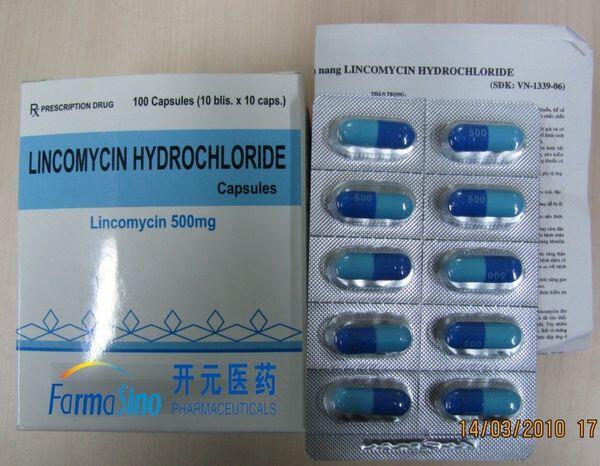
When given orally to one group of children as single doses of 22 to 33 mg/kg, lincomycin hydrochloride produced mean peak plasma concentrations of 4 to 9 micrograms/mL. After intramuscular administration of 600 mg lincomycin hydrochloride in healthy adults, peak plasma concentrations occurred within 30 minutes and ranged from 9.3 to 18 micrograms/mL; plasma concentrations ranged from 1.3 to 3.2 micrograms/mL at 12 hours, and detectable concentrations could persist for up to 24 hours. After intravenous infusion of 600 mg lincomycin hydrochloride over 2 hours, post-infusion plasma concentrations averaged 15.9 to 20.9 micrograms/mL.
Distribution
Lincomycin is distributed into many body tissues and fluids, including peritoneal fluid, pleural fluid, synovial fluid, bone, bile and the aqueous humour of the eye. The manufacturer states that a subconjunctival injection of 0.25 mL of a solution containing 300 mg of lincomycin per mL will produce inhibitory concentrations in ocular fluid for most susceptible organisms for at least 5 hours.
The medicine passes poorly into the CSF; however, when the meninges are inflamed, low concentrations of the medicine (18% of the concurrent plasma concentration) have been reached. The concentration of lincomycin in bone is reported to be 20-33% of concurrent plasma concentrations.
Lincomycin readily crosses the placenta, and cord blood concentrations have been reported to be 25% of concurrent maternal blood concentrations. Lincomycin passes into breast milk, and concentrations in milk may be equal to maternal plasma concentrations. At a plasma concentration of 5 mcg/mL, lincomycin is about 72% bound to plasma proteins; at a concentration of 1 mcg/mL, it is about 57% bound to plasma proteins.
Elimination
The plasma half-life of lincomycin is 4 to 6 hours in patients with normal renal function. In patients with impaired renal or hepatic function, the plasma half-life increases in proportion to the degree of impairment. Plasma half-lives of up to three times the normal value have been reported in patients with severe renal impairment. Plasma concentrations of lincomycin are not significantly affected by haemodialysis or peritoneal dialysis, or by prolonged administration in patients with normal renal function.
Lincomycin is partly metabolised in the liver, and both the medicine and its metabolites are excreted in urine, bile and faeces. After oral administration of 500 mg of lincomycin hydrochloride, 1-31% of the dose is excreted in urine and as much as 40% of the dose is excreted in faeces. After parenteral administration of 600 mg of lincomycin hydrochloride, 1.8-30.3% of the dose is excreted in urine and 4-14% of the dose is excreted in faeces.
Chemistry and Stability
Chemistry
Lincomycin is an antibiotic obtained from cultures of Streptomyces lincolnensis. Lincomycin is commercially available as the hydrochloride monohydrate. The medicine is a white to off-white crystalline powder that may have a faint odour and is freely soluble in water.
The pKa of lincomycin is 7.6. Lincomycin hydrochloride injection is a clear, colourless to slightly yellow solution; hydrochloric acid and/or sodium hydroxide may be added during manufacture to adjust the pH to 3-5.5.
Stability
Lincomycin hydrochloride capsules and injection should be stored at 20-25°C; freezing of the injection should be avoided, and the capsules should be kept in tightly closed containers. Lincomycin hydrochloride is reported to be physically compatible for 24 hours at room temperature in the following IV infusion fluids: 5% or 10% dextrose in water or 0.9% sodium chloride, Ringer's, 1/6 M sodium lactate, 6% dextran in 0.9% sodium chloride, and Travert® 10% Electrolyte No. 1.100 Lincomycin hydrochloride has been reported to be incompatible with various medicines, but compatibility depends on several factors such as medicine concentration, the specific diluents used, resulting pH and temperature. Specialist references should be consulted for specific compatibility information.
Storage
Store lincomycin capsules and injection at 20-25°C (68-77°F). Keep capsules in a tightly closed container and protect them from moisture. Avoid freezing the injection and protect it from excessive heat and light. Keep all medicines out of the sight and reach of children.